

Secrets du Siam
From a dead-end chatbot to an AI agent that books the call.
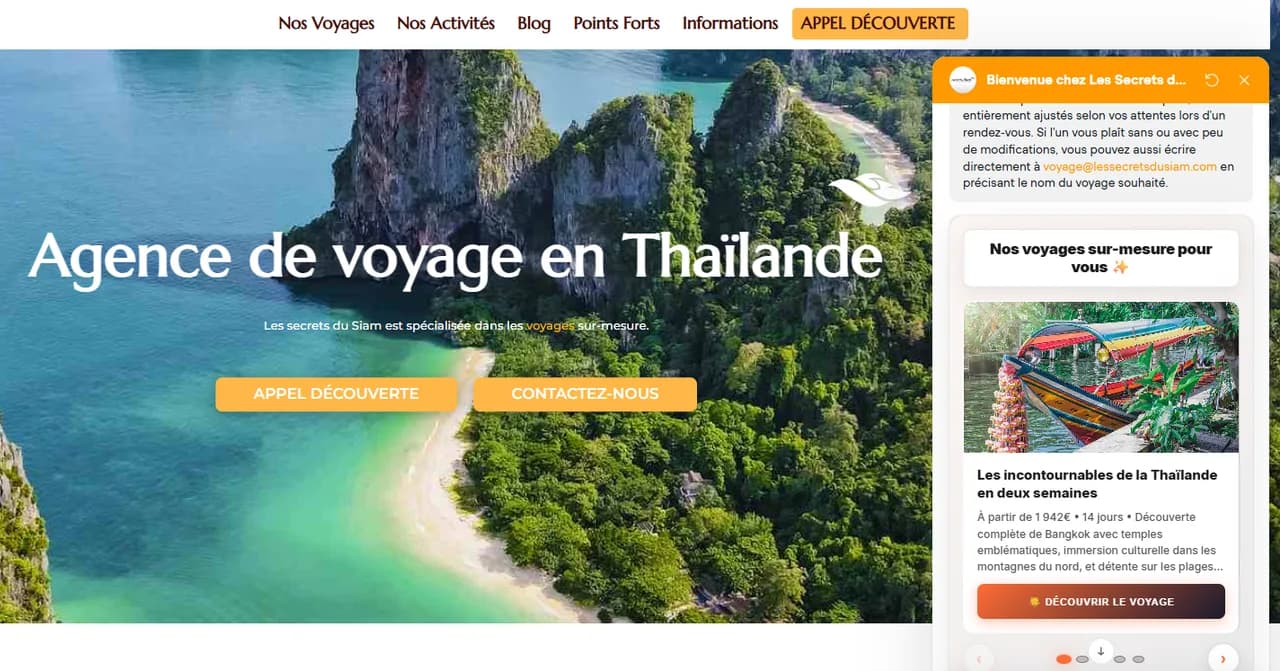
Secrets du Siam ran a scripted Tidio widget that stalled ready-to-book travellers. We replaced it with a custom conversational agent that qualifies them and schedules the discovery call, at a lower running cost.
Project card
- Client
- Secrets du Siam
- Sector
- Travel
- Country
- France
- Delivery
- Delivered by our team through its European experience (Evolution Agency, France).
24/7
qualification and booking of the discovery call, without waiting for the team
No script
travellers ask in their own words, where the old widget stalled them
Lower cost
running the agent versus the previous Tidio subscription
Methodology: the volume figures on this page are those reported from operating the agent, which logs every conversation in the agency's follow-up sheet. We publish client-specific percentages only once they are measured and approved.
Context
Secrets du Siam is a Thailand-focused travel agency selling tailored trips. Like most agencies its size, the website ran a Tidio chatbot: a scripted, button-driven flow that answered a fixed menu and stalled the moment a traveller asked something off-script.
Travel enquiries are messy by nature: dates, budget, party size, what to see and what to skip, season, visas. A decision tree cannot hold that conversation. The bot was a deflection tool that deflected the wrong things: it pushed engaged, ready-to-buy visitors into a dead end instead of into a booking.
Challenge
Three problems, one root cause. The brief was not to add another chatbot. It was to replace the rented script with an owned agent that actually converts, in the languages travellers speak, and that hands the sales team qualified calls instead of transcripts.
The scripted bot could not qualify
It captured clicks, not intent, so the sales team received either nothing or noise.
It could not act
It could not propose a slot or book a discovery call, the one action that turns a curious visitor into a pipeline lead.
It billed for a low ceiling
A recurring SaaS fee for a tool whose limits were baked in by design.
Solution: an agent that qualifies, books and writes back
We replaced Tidio with a custom conversational agent built on a large language model. The difference is structural: a chatbot answers, an agent qualifies, books and writes to the system.
- 1
A real conversation
The agent holds a natural conversation about the trip in the traveller's language, grounded in the agency's actual offer so it never improvises prices or itineraries.
- 2
Qualification in context
It captures the constraints that matter (destination focus, dates, budget band, party size, language) and turns them into a structured lead instead of a click log.
- 3
Booking inside the conversation
When intent is clear, the agent proposes a slot and books the discovery call directly in the chat: the action that turns a curious visitor into pipeline.
- 4
Owned system, controlled costs
The agency trades a recurring SaaS subscription for a system it owns: an isolated embed that loads without breaking the page, and a model-abstraction layer so there is no vendor lock-in and a lower cost per conversation.
Results
Every conversation and every booked call is logged in the agency's follow-up sheet. Volumes and rates will be published once measured and approved.
Qualified discovery calls booked directly in the conversation
Traveller questions answered at any hour, in their own words
Running costs below the previous Tidio subscription
The sales team receives qualified discovery calls instead of click transcripts
The honest framing: the agent does not replace the travel advisor. It protects the advisor's time by absorbing the repetitive front end and surfacing only the travellers worth a human call.
Stack
Your chatbot answers. Should it be booking?
Evaluate your project free with our interactive tools: they will tell you where a real agent converts, and where it does not.